Showing posts with label politics. Show all posts

Saturday, April 28, 2012

Farm Safety: The Real Story

U.S. Labor Department has just withdrawn a set of proposed safety regulations for young people working in agriculture. The regulations proposed to disallow children under 16 from operating machinery with power takeoffs, and from working in feed lots, grain silos and stockyards.

Under these regulations, my brother wouldn't have been able to pay for his university education by farming my grandmother's land. And my dad wouldn't have been able to tell the story about riding his bicycle down the road when he was ten, and seeing a driverless tractor coming toward him. As it approached, he realized it was being driven by his five-year-old cousin who couldn't be seen above the steering wheel. My brother and my dad's cousin survived, just as I survived using the rotary mower, as a subcontractor mowing besides the railway tracks, at age 13.

But the thing is, my dad didn't survive a farm accident, three years ago. Farming is dangerous. A Stats Canada Report shows that "Agriculture is one of the industries with the highest rates of fatal injury. From 1991 to 1995, that rate varied between 14.9 and 25.6 per 100,000 workers in Canada... Agricultural production thus ranks as the fourth most dangerous sector, behind mining, forestry and construction ...With regards to non-fatal injuries among agricultural producers, studies indicate that annual frequencies are generally in the range of 5% to 10% of the population." It's not just because the average age of farmers is really high: the injury death rate for young children who live on farms is almost twice that for all young children in Canada.

Maybe it is more effective to educate about farm safety than to disallow children from working on farms - this is the tack the American government is going to take. However, I think there are two essential pieces to this news that have not been emphasized. First, these labour laws would not have applied to children working on their parents' farms. How many children under the age of fifteen (need to) work on other peoples' farms? Yet, it wasn't only 4-H instructors complaining about these laws. News articles were full of emotional manipulation like this:
e here: http://www.sacbee.com/2012/04/27/4447875/child-labor-groups-upset-farm.html#storylink=cpy

On the Sombke family farm four kids learned everything they know about the trade from their parents..."I wouldn't have worked out here, I would have taken a completely different, completely different path in life," Brett Sombke said.
The Republicans were all over this overblown rhetoric, for their own political gain. However, despite the wholly inaccurate portrayal of the proposed laws in this article, the closing paragraph holds the key to another very important piece of the puzzle:
Brett says it's hard enough to find people to work during the spring and fall. He says that without kids being able to perform certain tasks on family farms the traditional meaning of family farm could end.
None of the farm groups protesting this law have mentioned the bigger issue behind it - the need for cheap or free labour on family farms. How many bankers or plumbers do you know who need to take their kids to work just to keep food on the table? (Hint: none.) And it's not because they are so much better at their jobs than family farmers are at theirs. It's because small family farmers are getting screwed every which way by input sellers, by processors, by commodity speculators, by consumer expectations of cheap food.

And *that* is the real problem.

And, it might even have something to do with farm safety. Stats Canada also says that farm receipts are inversely proportional to farm accidents.

Monday, April 16, 2012

Can't see the forest...


In the city where I live, every single tree was hand-planted. There are over 350,000 of them. "Oasis" is probably a fair descriptor, given that we are also located in the semi-desert Palliser's Triangle and get 15 inches of annual precipitation.

We also happen to be frequently ravaged by winds - 22 km/h is the average, but a recorded high wind gust clocks in at 153 km/h. And our temperatures typically range from -40 (Celsius or Fahrenheit) to +40 (Celsius).

So, despite the fact that tall trees are not native to our area, it's understandable that our ancestors planted so many. On farms, they prevented soil erosion from those constant winds, reduced moisture evaporation, provided wildlife habitat and increased biodiversity, protected livestock, trapped snow, reduced heating and cooling costs by sheltering nearby buildings, and made everything look nicer. Now, we also value them as carbon sinks.

This is why the federal government's decision to cut the Prairie Shelterbelt Program is ridiculous. This 111 year program has provided more than 650 million seedlings to farmers, and was a major factor in ameliorating the effects of the Dirty Thirties.

Our ag minister argues that, due to no-till and continuous cropping, trees aren't needed to prevent soil erosion; in fact, they get in the way of the big machinery used by big farmers - or, as our premier calls them, "producer-entrepreneurs of the highest order". Maybe our ag minister, a failed ostrich farmer, doesn't know about all the other benefits of trees. It's certain that he's not listening to the scientists who are trying to tell him.

I'll let William Blake have the last word:


"A fool sees not the same tree that a wise man sees."
- 
William Blake, Proverbs of Hell, 1790   

Monday, March 5, 2012

Buying Green

Did you get the impression, on Feel-Good Friday, that I was lightening up on the "vote with your dollar" movement? Well, it's Monday morning now.

From the Climate and Capitalism blog's review of Kendra Pierre-Louis' Green Washed: Why We Can’t Buy Our Way to a Green Planet:

Her new book Green Washed is a powerful critique of “the comforting message that we can shop ourselves out of our current environmental mess.”
“Too many businesses and environmental groups have led us to believe that if we buy the correct collection of products, we can save the planet. While these assurances have done much to assuage our collective guilt, and even more to create a generation of smug eco-shoppers, it has done next to nothing to fundamentally change the environmental landscape, while in many cases actively contributing to environmental degradation and misinformation.”
So far so good? Pour yourself a warm beverage into your reusable mug and lean back. 

In refreshing contrast to most books on consumerism, Green Washed pins the blame for excess consumption on our economic system, not on individual psychology.
“If we were to make reducing our consumption to a level that was both materially satisfying and ecologically sustainable our central focus, our entire global economic system would collapse. This isn’t a hyperbole. Our economic system is based on the need for perpetual growth; we either grow our economy or it dies, taking us along with it.”
Hm. Food for thought. Take a bite of that muffin.

Unfortunately, Pierre-Louis’s analysis of causes stops with criticism of growth. She doesn’t ask why the global economic system is so irrational. Why is the only alternative to one polluting product so often another that pollutes as badly or worse? Many brilliant writers have criticized growth, and offered detailed proposals for steady-state economies – why have they been ignored by those in power? What about our existing social and economic order makes growth so essential and environmental destruction so universal?

Because it doesn’t pursue those questions, Green Washed proposes band aid solutions when major surgery is needed. Having firmly rejected individual green shopping, the alternative Pierre-Louis offers amounts to green shopping in groups.

And the bracing shock of cold water. 

Projects that improve the sustainability and resilience of local communities are important, but they are no substitute for political and social action against the global forces that are destroying our world. Unless we stop and reverse those forces, Pierre-Louis’s shadow economies will be small green islands in an ocean of environmental destruction – and water levels will continue rising.


Back to work.

Monday, February 13, 2012

Monsanto wants you to vote with your dollar.

A lot of North American food movements ask you, the consumer to "vote with your dollar'. You can hit Walmart where it really hurts, in the pocket book! Buy local! Buy non-GMO! Buy at farmers markets!

With the lobbying power of agribusiness, and the revolving door between government agencies and agribusiness corporations, it can seem that voting with your vote is useless.

But guess what? Monsanto secretly loves the "vote with your dollar" campaign. So does Nestlé. And McDonalds. Here's why:

They know that an average Canadian spends only eleven percent of their income on food. Most of us expect our food to be cheap. We whine and wail when prices go up. We complain about adequately remunerating farmers if it means our cheese might be a few dollars more than across the border where dairy farmers commit suicide because of low prices. Very few of us will buy higher priced food if lower priced food is unavailable. This is a major reason why organics is still a niche market, making up less than one percent of total household food purchases in Canada.

It gets worse. There are many of us, despite that 10% average, who cannot spend more on food : 851,01 people used food banks in March of 2011, and this is not the highest recorded number in the past few years. So, this campaign effectively excludes these people. Now those who vote with their dollar can be framed as elitists and sneered at, and those who don't can be judged as morally inferior.

Putting our trust in niche markets allows the co-optation of food movement initiatives. They become another segment to either capture or hedge. We see this with Walmart introducing a line of organic food, but the most blatant example is that of Gerber the baby food producer, which vocally prohibited GMOs in its products at the same time as its owner, Novartis, continued to develop and sell genetically modified seeds. They got you coming and going, damned either way.

And that's not the worst part. I've been wanting to write about the worst part for a long time, but I also want to support these progressive people who encourage us to vote with our dollar and are doing good work in the food system. I don't want to seem overly critical. But when I watched "Fresh" - an excellent movie - I cringed at the end when the co-op manager told us voting with our dollars was the best way to make change. When an anti-GMO campaigner insisted that labelling and avoiding GM foods was the best way to make change, I almost bit my tongue through. Finally, I've been pushed past the point that I can keep silent by an excellent article by Robin Jane Roff, "Shopping for change? Neoliberalizing activism and the limits to eating non-GMO".*

Here's the essential problem with voting with our dollars. It posits the market as the answer, when the market is the problem. It's like that definition of insanity - doing the same thing over and over and expecting different results.

When we turn to the market to fix what's wrong, we are putting the (super)market, rather than governments (and voting citizens) at the centre of the food system - as Roff puts it, the market becomes"the ultimate arbiter of socio-environmental quality". This is the same market that works on the principle of deregulation and privatization that has lead to disastrous environmental problems and social ills in the pursuit of shareholder profit – that indeed benefits from these ills, because it almost always does not have to account for them. This is the market that gives us cheap pork – and creates a giant dead zone in the Gulf of Mexico. It gives multinational agribusinesses record profits during the food crisis in 2008 when millions became food insecure and faced starvation.

When we decide that the market is where we must turn our efforts, we change from being citizens with food rights and entitlements to consumers with food choices and responsibilities. Are the problems created by the food system, then, of our choosing – we didn't spend our dollars in the right place? Do we decide then, that it is our responsibility, through charitable donations, to feed the hungry, rather than the responsibility of governments (by the people, for the people) to respond to society's needs? Is it our fault, because we didn't choose the organic pastured pork, that Lake Winnipeg is choking to death? What's that you say, they didn't have the choice of organic pastured pork at Superstore? Did you want it enough?

Voting with our dollars encourages us (not that we need more encouragement) to think of ourselves as individuals, making individual decisions, rather than a community or a society. One thing this allows is the belittling of problems. For example, if you look into the pro- and anti-organic arguments, you'll soon find the claim that organic food has minimal health benefits over non-organic food, and the pesticide residue on produce is negligible for the consumer. This blatantly ignores the benefits of organic growing for pollinators, birds, the water table, and farm workers – to name a few non-consumers.

Framing eaters solely as individual consumers is also much more limiting than framing them as citizen-activists. As Roff says, “by replacing ‘‘consumer ’’ with ‘‘citizen’’ not only does the problem suddenly become political-economic not just economic, but a wealth of solutions and counter movements become imaginable. The space of opposition is no longer restricted to the domain of the market, but now encompasses the full breadth of structures and social relations. The idea of the market and consumption can themselves become targets of critique.” 

Fundamentally, consumption-based change is not transformative. Which is preferable - to label foods containing GM ingredients so that consumers can avoid them if they can afford to, until so much of the soy and corn and alfalfa are contaminated and so many new GM varieties are introduced that very few non-GM products exist - or, to ban GMOs? Which is preferable - that a few supermarkets that succumb to the pressure of privileged consumption choices decide to source tomatoes from growers that pay a living wage, or that a minimum wage is legislated for farmworkers (as it isnot, with few exceptions, in Alberta, Manitoba, Ontario, andSaskatchewan). So, it's political. And yes, governments are corrupted and hard to influence; this tendency must be challenged.

But a bigger point is that the food system is not only about the food system. A truly healthy, sustainable food system would require, for consumers, living wages, a shorter work day, an end to gender inequality, and participatory democracy. Problems with the food system can not be dealt with solely by the existing power of a relatively wealthy middle class, but by empowering marginalized people and disempowering giant corporate entities.

When you buy food, please do buy ethically grown, low-impact, and healthy food. But I challenge you - if you think the system needs to change - to do a little more, and do it together.

I'll end with a final note from Roff: “If we truly want a socially and environmentally equitable food system then we can not continue to rely so heavily on the mechanisms that created the one we currently have.”

*Agriculture and Human Values (2007) 24:511–522.

Friday, November 18, 2011

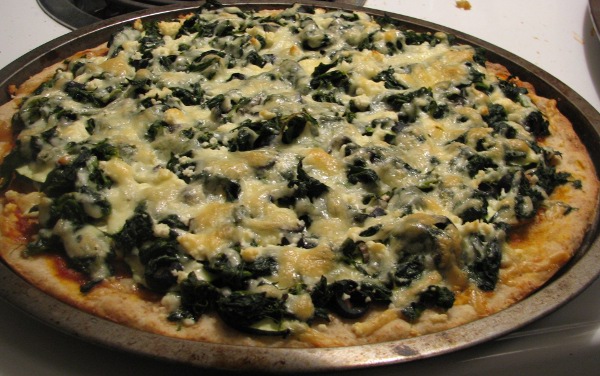
Ketchup may no longer be a vegetable, but pizza is.

If you've been following American food news, you've probably heard that the US Congress has voted to make pizza a vegetable. (No, the link isn't to a Wall-E clip.) More precisely, the guidelines for nutrition in  school lunches now assert that the two tablespoons of tomato sauce on a slice of pizza counts towards the weekly calculation of vegetable servings. The proposal to limit servings of potatoes (often in the form of hashbrowns and fries) per week was also dismissed.
Probably not this pizza.
I went to a "community school" for grades seven and eight. It was located in a newly gentrifying area, and had a mix of incomes represented, tending to the lower end. It didn't have a cafeteria or lunch program (very few schools in the city did) but I remember getting weekly donations of free muffins. I usually chose chocolate-chocolate chip: sweet, fatty, calorie-dense, likely nutritionally void. It didn't occur to me at the time to wonder at the donation. Cynically, I wonder now - was it a tax write-off? Past-date goods? An attempt to make us future muffin customers? Or just a treat for the poor kids? What, exactly, was the purpose of the muffin?

It is hard not to be cynical when looking at the lobbying that was behind Congress's decision. Food companies including ConAgra, Coca-Cola, Del Monte Foods and makers of frozen pizza like Schwan argued that the proposed rules would raise the cost of meals (14 cents per meal according to the Department of Agriculture) and require food that many children would throw away.

Here's some background on school lunches in the United States.
In fiscal year 2009, federal school nutrition programs underwrote more than five billion meals served to over 31 million students. Students are entitled to free lunches if their families’ incomes are below 130 percent of the annual income poverty level guideline established by the U.S. Department of Health and Human Services and updated annually by the Census Bureau ($29,055 for a family of four in 2011). Children who are members of households receiving food stamp benefits or cash assistance through the Temporary Assistance for Needy Families block grant, as well as homeless, runaway, and migrant children, also qualify for free meals. Students with family incomes below 185 percent of poverty are eligible for a reduced price lunch. Of the five billion meals provided to 31.8 million students during the 2008-09 school year, 55 percent were free of charge, 10 percent were reduced price, and the other 35 percent were paid.
That's 17.5 million children living in poverty. Surely there is a duty to provide them with nutrition, not the cheapest mass-produced schlock available. If the government is not going to address societal problems that perpetuate poverty, is not properly funding and regulating school meals the least it can do?

Libertarians will cry, "It's the parents' responsibility!" Sure, in an ideal world, with parents who have nutritional knowledge, cooking skills, and access to cheap, healthy ingredients. We don't live in that world. Let's work with the one we have.

Wednesday, September 7, 2011

Tyranny of the Majority

I've changed my mind about the Canadian Wheat Board. I now actively welcome its demise, as the result of an irresistible argument that you may have heard making the rounds. It goes like this:

24.32% of voting-age Canadians voted for the Conservative government and gave it a majority. These voters included Torontonians who couldn't tell a wheatfield from a field of flax and have never heard of the Canadian Wheat Board. Nevertheless, this win obviously gave the government a mandate to repeal the Act of Parliament that gave the CWB its monopsony over prairie wheat and barley. This is a far more democratic way of dealing with the farmer-funded organization and its farmer-elected representatives. In the name of 'marketing freedom', the Conservatives will overturn this tyrannical majority rule and wheat and barley farmers will be able to sell to whichever of the four multinationals that control 80% of the grain trade they choose.

In light of this persuasive argument, I too have chosen to embrace the principles of 'minority rules' and 'freedom of contract'. I hereby announce my choice to disregard the laws of my country, some of which I personally do not benefit from and did not personally approve of. Therefore, as an underrepresented minority, I refute our electoral system whereby the majority controls the political system, and the unfair laws that support that system. My household and I have freely contracted with the government of Norway and are now Norwegians.

Wednesday, June 22, 2011

More than Speculation on Speculation

Sent to the Minister of Finance:

Dear Mr. Flaherty,

I was absolutely appalled to read your comments to Reuters Insider TV on Wednesday June 15 in regards to France's proposal to tighten controls on commodity speculation. You are quoted as saying, "We try not to interfere in markets, including the food market...Markets will find their price levels. We know that's sometimes difficult in the oil situation and so on ... it's discomforting, but in the long run it's the best policy and we maintain our belief in open markets."

In essence, you are saying that the hunger and starvation caused by food shortages and high prices as markets "find their price levels" - in turn influenced by speculation - is "discomforting"! This apparent lack of sympathy with hungry people in Canada and abroad is both arrogant and cruel. If, indeed, you did not mean to say this, I urge you to clarify your remarks.

As for the speculation, which Agriculture Minister Ritz believes does not effect prices, you may wish to educate yourself on the effect that it does, indeed have. I recommend the following:

FAO (2010) ‘Final Report of the Committee on Commodity Problems: Extraordinary Joint Intersessional Meeting of the Intergovernmental Group (IGG) on Grains and the Intergovernmental Group on Rice’

O. de Schutter (UN Special Rapporteur on the Right to Food) (2010) ‘Food Commodities Speculation and Food Price Crises: Regulation to Reduce the Risks of Financial Volatility

C. Gilbert (2010) ‘How to Understand High Food Prices’, Journal of Agricultural Economics

World Bank (2010) ‘Placing the 2006/2008 Commodity Price Boom into Perspective’.

*I know there are people out there who disagree with my opinion. Please educate me in the comments!

Wednesday, May 25, 2011

Conservatives snub democracy, farmers with move to dismantle Wheat Board

I couldn't be silent on the issue of the Canadian Wheat Board. It's in my blood. This is an article I wrote that will be appearing in a provincial NDP newsletter in June (so bear in mind the audience, when reading). For another angle that brings in the labour movement, see Simon Enoch's article.

On May 17, Conservative Agriculture Minister Gerry Ritz terminated a longstanding debate in Western Canada by announcing his government's intention to end the Canadian Wheat Board's monopoly on marketing wheat and barley.

On one level, the debate is economic – do farmers do better with a monopoly seller representing them in the global marketplace by pooling their grain and sharing the average proceeds? This question has been conclusively answered 'yes' by many academic studies and trade inquiries.

However, the real issue at stake is an ideological one. The anti-CWB side argues private entrepreneurs should have the economic right to market their own grain and barley and compete with each other for the best price. The pro-CWB side argues in favour of economic cooperation and food sovereignty - values that have historically typified the Canadian farm movement and were crucial in the CWB’s formation.

The Canadian Wheat Board evolved in response to western farmers' lack of market power in the early part of the twentieth century when federal government policy set up the West as cheap providers of raw materials for Eastern industry. These farmers felt powerless against duopolistic railways, elevator companies, and the Winnipeg Grain Exchange. In the face of this, farmers' natural inclination was to take matters into their own hands, acting collectively for the good of the farm community: the Grain Growers Grain Company, the Wheat Pools, and finally the Wheat Board – made mandatory in 1943 – resulted.

Through its three guiding principles - single desk selling, price pooling, and government guarantees - the Wheat Board provides stability and market power to farmers. Unlike a private grain company, whose shareholders demand ever-increasing profits, the Board returns more than 95 per cent of its sales proceeds to farmers.

Of course, this is only part of what the CWB does. The Wheat Board also uses its considerable influence to advocate for farmers with Canadian National and Canadian Pacific, taking these railways to court when they have provided substandard service to farmers. The CWB also invests heavily in wheat and barley research, funding 60 per cent of the Canadian International Grains Institute. The Wheat Board has spent decades building markets that promote the superior reputation of Canadian wheat. These are services that the private sector either will not currently perform or will only do for a profit.

The Wheat Board is one of the last major institutions created by our ancestors to support prairie farmers. Farmers have lost other farmer-controlled institutions such as the Pools and supportive government programs such as the Crow Rate. In a situation that hearkens back to the 1900s, western farmers today are at the whims of a duopolistic rail transport system and the four companies who control more than 80 per cent of the global grain trade. More than an economic loss, though, the destruction of the Wheat Board seems to indicate the destruction of the cooperative values of our Saskatchewan farming ancestors.

Perhaps the most relevant lesson from the Wheat Board's impending demise for both rural and urban folk involves the federal government's conception of democracy. CWB opponents claim the recent election of a federal Conservative majority government, regardless of the tiny percentage of those voters who are farmers, means that the government has a clear mandate to kill the CWB.

CWB supporters point out that there already is a democratic mechanism to change the Board’s mandate. Since 1998, farmers who sell wheat and barley have the democratic right to elect directors to the CWB to carry out their wishes. And, since these elections began, 70 per cent of farmers have consistently voted in pro-CWB directors.

It's hard not to see Ritz's termination of the Wheat Board debate as a continuation of Conservative attempts to erode democracy by bypassing democratic processes, ignoring stakeholder desires, and ruling autocratically. For our food system, it means that we have lost control of a major staple and a major counterforce to multinational agribusiness giants.

Monday, April 25, 2011

Rural Development

Gentle readers, those of you who are back-to-the-land types may want to vote Conservative if Scott Feschuk's predictions of what a minority government will mean are accurate:

But what if we decline to give Harper what he wants? Dear citizens, the potential consequences are too imaginary to imagine! Our prosperity may crumble. Quebec may separate. Within a week to 10 days, our financial system may revert to a farm-based barter economy. Friends, you’re going to wish you voted in a Conservative majority when you try to purchase a bindle and the sales clerk doesn’t have change for a rooster.

Thursday, April 14, 2011

Ugliness.


Folks, I have to do it. It's not going to be pretty, but I feel that it's time to get to the ugly heart of it all. I know that some of you will be shocked, others disgusted, and many will turn their eyes away, perhaps for good. But there is a cry arising in the land, a cry that must be answered:


    “Please – won't someone think of The Economy!”
The Economy, that giant demi-god infant threatening to throw a tantrum that we, the fearful permissive parents, must court, pacify, but never, ever restrict. That volatile baby whose motivations we can only guess at with baffled dimness, or the guidance of experts who study the demanding creature in a controlled environment instead of in our messy, complex everyday lives. Instead of something that serves us, that is embedded in our social relations, The Economy is our foremost concern and society a mere adjunct to the market. The Economy has a life of its own, and in that it controls all of ours; the economic sphere is depoliticised, naturalized, privatised, and thus "rendered democratically unaccountable".*

What does this have to do with food?

It is my firm belief that food, and the other essentials of life such as water and air should not be commodities. They should not be ruled by economic considerations, and indeed, have not been for long in humanity's history. In most other times and places, they have been regulated by considerations such as equality, redistribution, status, religion - not accumulation of wealth.

When food is sold and traded for profit, it is pretty obvious, if you look at how any other commodity functions in our society, that the results are not in the best interests of the population. It will be scarce at times; overabundant and devalued at others; speculated upon; hoarded; shoddily and mass-produced under the guise of efficiency; underregulated as far as safety, and overregulated as far as trying to fit it into one nice, neat, industrial box; increasingly homogenized; overpackaged and overmarketed; increasingly unsatisfying of our deeper hungers.

This results in injustice. Unequal distribution. Unequal access. Bad tasting food that is nutritionally marginal. Haiti having been self-sufficient in rice now dependent on imports from the US. Kenyans working in greenhouses to produce 7 tons of perfectly straight beans to send to France and 6 tons to rot in the fields**. One Earth Farms intending to own one million acres of land in Saskatchewan and employ seasonal wage-labourers in neo-serfdom.

The costs of externalities such as the eventual costs of declining soil fertility and tilth, water pollution from factory farm sewage and crop overfertilization, and climate change exacerbation from oil-dependent agriculture, are not borne by those who have defined the system, commodified the food, and profited from its turning into a commodity – the retailers, wholesalers, marketers, shippers, processors, speculators, and input manufacturers.

I'll discuss some possible answers to "what can be done about this?" in future posts. For the present, attempting to provision oneself outside the capitalist industrial agri-food system is a good start. And I think Canadians, in particular, at this moment, need to think about what is being sacrificed, and what is being gained, in the name of The Economy, in the short and long terms. (Here's a link to the food policies in the platforms of each of the federal parties.)

* borrowing an idea and phrase from Rupert, Mark. (2003). Globalising common sense – a Marxian-Gramscian (re-) vision of governance/resistance. Review of International Studies 29, 181-198.
**Roberts, Paul. (2008). The End of Food. Boston: Houghton Mifflin.

Thursday, March 31, 2011

Writing to my MP

I thought this might be a timely topic given the election fervour/torpor that has gripped the nation.

I enjoy writing to MPs to test their willingness to engage in discussion, as a measure of how accountable they seem to feel to their voting public. I have gotten personalized (and personal) responses from the NDP and Liberal Agriculture critics, as well as the lone Saskatchewan Liberal MP. My success has not been so great with my own MP.

What follows is the text of emails we exchanged on the issue of Bill C-474, a private member's bill from the NDP's Alex Atamanenko that asks for a market assessment of harm before any approval of new genetically engineered crops. My first email each time is a modified version of a form email from C-BAN. My MP's responses... may be his own. You be the judge. If you make it to the end, that is.


Me on Mar 17, 2010:
Dear Anon., MP

Thank you for your responses to my earlier emails. I appreciate the time you take to consider constituents' concerns. I am writing again with another agriculture-related concern to ask you to support Private Member Bill C-474, when it is debated at second reading in mid-March.

The Bill would support Canadian farmers by requiring that “an analysis of potential harm to export markets be conducted before the sale of any new genetically engineered seed is permitted.”

This Bill is really important because, as we know from experience, the introduction of new genetically engineered (GE) crops can cause economic hardship to farmers. Since Saskatchewan farmers primarily produce crops for export, this is a crucial concern.

Farmers are at risk when GE crops are commercialized in Canada without also being first approved in our major export markets.

Flax farmers in Canada are now paying the price for this exact problem. Late last year, Canadian flax exports were discovered contaminated with a GE flax that is not approved in Europe or any of our other export markets.

Flax farmers actually foresaw that GE contamination or even the threat of contamination would close their export markets. This is why they took steps in 2001 to remove GE flax from the market. Despite this measure, flax farmers were not protected.

The GE flax contamination has created market uncertainty and depressed prices. Farmers are also paying for testing and cleanup and may be required to abandon their own farm-saved flax seed and buy certified seed instead. These costs are an unnecessary and preventable burden.

We cannot allow our export markets to close like this again. It is the government’s responsibility to protect Canadian farmers from predictable problems caused by the introduction of new GE crops that have not yet been regulated in our export markets.

Anon., please support Bill C-474 and protect Canada’s farmers and our markets.

Yours Sincerely, etc.


MP's reply on 26 March:

Dear Ms. Blogger,

Thank you very much for your email regarding Bill C-474, a Private Members Bill, an Act respecting the Seeds Regulations introduced by Mr Alex Atamanenko of the NDP.

The Government of Canada has always regulated for food safety and health and will continue to examine new products with that as the guiding principle. We are confident that environmental and economic interests are best protected in this fashion.

It is unfortunate that Bill C474 has so many negative consequences. If this Bill had been previously passed by Parliament, there would be no canola industry in Canada - the $12.2 billion dollars that is generated annually in Western Canada would be lost. Bill C-474 adds more regulatory burden on the entire value chain without contributing to our ability to innovate, compete and provide valuable crops to feed and fuel a growing world.

Bill C-474 would also have hampered the ongoing development of the soybean industry. Over half of the soybean production in the world is GMO and these products have revolutionized soybean production. Millions of people around the world benefit from this technology which (NDP MP) Mr. Alex Atamanenko and his party oppose. Mr. Atamanenko uses the past years flax challenges as his reason for why we need this Bill. He is playing games with Triffid flax - that specific example has nothing to do with this Bill.

The Bill will clearly restrict technology and science. New technology holds the key to future prosperity. The clauses of this bill fail to deal with the challenges and opportunities presented by new scientific developments. Instead they would impose an impossible burden, requesting an unscientific 'analysis' that must be based on future prophecies and projections rather than on issues of food safety and health.  The Bill also ignores producers - failing to ask for an analysis of the possible benefits of new varieties to our producers.

While I appreciate your concerns regarding what happened in the flax industry, I believe that this Bill is not the way to address those issues.

Thank you for taking time to express your concerns to me on this piece of legislation. Should you have any comments or concerns, please do not hesitate to contact my office.

Sincerely, etc.

My response March 31:
Dear Mr. Anon.,

Thank you for taking the time to respond to my concerns. We seem to be at odds on certain points, so I would like to explain further a couple of key issues that were elided in your response.

First, the argument that there would be no canola industry in Canada with Bill C474 is a red herring. Canola was developed before widespread opposition to GMO's, and the current GM variety is opposed in countries such as Australia. As well, if we want to talk canola, it must be mentioned that canola was developed in a public university, not by a private corporation that siphons off the benefits. The case of GM soybeans, which you mention, clearly shows that the majority of benefits go to the owner of the patent. In this way, GM crops have very little benefit for farmers (many of your constituents) who must buy seed year after year instead of keeping it, and who must pay licensing fees, and many other nickel-and-dimed-to-death costs associated with GMOs. The NFU, on behalf of many farmers, has researched these issues and speaks on their behalf in calling for a ban. Your call for an analysis of cost-benefits to producers is reasonable, but I believe that if you look more closely, this has been done already by various organizations.

There are also doubts as to whether soy is benefiting millions of people around the world, as you have claimed. Primarily, it is used as cattle feed, and those who eat the majority of the beef are found in North America and Europe, struggling with an obesity epidemic, while many poor people have been pushed off their subsistence farms so soybean farmers can produce for export. I fail to see how those poor benefit from GM soybeans.

Finally, you claim that this Bill will "restrict technology and science" which "holds the key to future prosperity." Surely you do not dogmatically accept that all technology is good and inevitable? Perhaps a dramatic example: Nuclear weapons and thalidomide should be unregulated?

Thank you for your consideration, etc.

NO ANSWER

And me again on Oct 22 when the Bill comes up again:

Dear Anon., MP

I am writing again to ask you to vote in support of Private Members Bill C-474 in order to protect Canada’s family farms. I also ask that you vote, on October 27, for a 30-day extension to the Agriculture Committee debate on Bill C-474. This debate is essential to sustain the presence of
democracy in our government.

As you know, Bill C-474 would support Canadian farmers by requiring that “an analysis of potential harm to export markets be conducted before the sale of any new genetically engineered seed is permitted.”

It is imperative that our government assesses the possible export market impact of introducing new GE seeds. Bill C-474 would simply require the federal government to conduct such an economic analysis.

Farmers are at risk when GE crops are commercialized in Canada without also being approved in our major export markets. For example, flax farmers in Canada are paid the price for unwanted GE contamination that damage their export markets late in 2009. Flax farmers foresaw that GE
contamination would close their export markets.

It’s the government’s responsibility to protect Canadian farmers from predictable problems caused by the introduction of new GE crops that have not yet been regulated in our export markets. Bill C-474 would help our government meet this responsibility.

The House of Commons Agriculture Committee has already heard a strong message of support for Bill C-474 from Canada’s alfalfa growers. On October 27, please vote in favour of a 30-day extension to the Committe hearings, to allow this important debate to continue.

Anon., please vote for Bill C-474 to make sure that alfalfa growers and other farmers do not face the same market harm caused by GE contamination that continues to hurt our flax farmers.

Yours Sincerely, etc.

His response on Oct 25:
Dear Blogger,

Thank you very much for your email regarding Bill C-474, a Private Members Bill, an Act respecting the Seeds Regulations introduced by Mr Alex Atamanenko of the NDP.

The Government of Canada has always regulated for food safety and health ... [see email from him, above]... Thank you for taking time to express your concerns to me on this piece of legislation. Should you have any comments or concerns, please do not hesitate to contact my office.

My response on October 25:
Dear Anon.,

I addressed your points about canola, and the other arguments you raise, already in a previous email. I'm sorry to see that you did not take that into consideration when re-sending me this email. I would appreciate an explanation of the assumed correlation between protection of health interests and economic/environmental interests that you refer to in your second paragraph.

Sincerely, etc.

NO ANSWER.


I tend to call it as I see it, so these letters above are actually models of restraint and courtesy on my part, and that of my patient husband who edited all but the last for courtesy and restraint. I'm not sure why I put so much effort into them. Now I just send him letters to use up 2 minutes of his - or a staffer's - time cutting and pasting a response. At least he works for 2 minutes a day, right?